



| Connection: | Flange |
|---|---|
| Brand Name: | No |
| Type: | Flange |
| Technics: | Casting |
| Material: | Stainless Steel |
| Head Code: | Square |
| Shape: | Equal |
| Model Number: | OEM |
| Place of Origin: | China (Mainland) |
Quick Details
Specifications
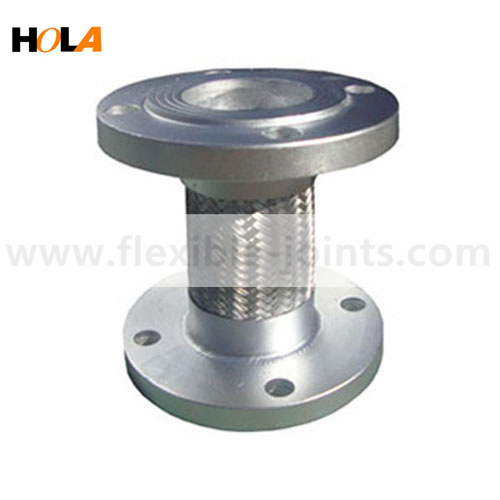
Flexible metal hose with ss braidingIs used to absorb pipe movements, relieve stress, reduce system noise/vibration, compensate for misalignment/offset and protect rotating mechanical equipment against start-up surge forces. Assemblies are designed for both high and low temperatures, as well as high pressure.
Features and Benefits
Compensate misalignment, absorbs vibrations in the pipeline
Wide Size and Service Range
for both high and low temperatures
SS304/SS316/SS321Materials available upon request
Flanges drilled per standard ANSI B16.1/150 lb. Pattern; other drilling patterns are available upon request
Is a flexible metal line element.Corrugated hoses can withstand high pressure and provide maximum Leak tightness on account of their material. Corrugated hoses also exhibit corrosion resistance and pressure Tightness under the most extreme conditions, such as in aggressive seawater or at extreme temperatures such as Found in space or when transporting cooled liquid gas. They are particularly well suited for conveying hot and cold Substances.
with a history of more than one hundred years, metal hoses have given rise to other flexible line elements, Including, metal bellows and semi-flexible and flexible metal pipes.
Corrugated hoses are pressure and vacuum tight. the permissible operating pressures for hoses with small Dimensions reach 380 bar (with a 3-fold burst pressure safety factor). the pressure resistance of large dimensions is Lower for technical reasons. Stainless steel models have a temperature resistance of up to approx. 600 C, Depending on the pressure load, and even higher values are possible with special materials. In the low temperature Range, stainless steel corrugated hoses can be used down to -270 C.
Structure and function:
are used as economical, flexible connecting elements that permit movement, thermal expansion and vibrations, and that can be used as filling hoses. the starting material is a seamless or longitudinally welded, Thin-walled tube into which corrugations are introduced by mechanical or hydraulic means using special tools.
Corrugated hoses are absolutely leak-tight and are used to convey liquids or gases under pressure or as vacuum Lines. They are also referred to as pressure hoses. Their special design achieves both flexibility and pressure rEsistance.
Application areas of metal hoses
with its ability to meet high demands for conveying hot and cold substances, this modern technology has the Following major areas of application:
Electrical industry and mechanical engineering: as a protective hose for electrical cables or light conductors
as a suction, conveying and coolant hose, e.g. When conveying and transporting liquid gas
Automotive industry: as an exhaust gas hose that acts as a vibration decoupler in exhaust systems
as a ventilation hose in technical building equipment Steel industry
Measuring and control equipment
Medical equipment
Aviation and space travel
Reactor technology
Regenerative energies (solar heat, wind turbines, etc.)
Stainless steel corrugated hoses are high-grade, highly flexible and impermeable structural elements for piping technology. They easily satisfy the requirements for this technology with regard to resistance to pressure, vacuum tightness, temperature stability, resistance to corrosion, flexibility and durability.
Braiding around metal hoses
to increase pressure resistance, Can be equipped with one- or two-layer braiding. the braiding is firmly Connected to the hose fittings on both sides to absorb the longitudinal forces caused by internal pressure. Due to Its inherent flexibility, the braid moulds itself perfectly to the movement of the hose. Hose braiding consists of right- and left-handed wrapped wire bundles that are alternately layered one over the other. this not only prevents hose Lengthening due to internal pressure, but also absorbs external tensile forces and protects the outside of the hose.
the basic material of the wire braid is usually the same as that of the corrugated hose. It is also possible to select Different materials in the interest of greater corrosion resistance or for economic considerations.
the braiding also greatly increases the resistance of the hose to internal pressure. the braid flexibly moulds itself to the movement of the hose. this applies even if a second braiding is used, which further increases pressure Resistance. the method by which the braiding is attached to the connection fittings depends on the type of fitting and the demands on the hose. under rough operating conditions, an additional round wire coil can be wound over the braid or the braid can be sheathed in a protective hose.
Functional principle of the metal braid
Wire braiding functions on the lazy tongs principle. When axial tension is applied to the hose, the braid reaches its Extension limit. this means that the wires lie tightly spaced with the smallest crossing angle, creating a hose Braiding of the smallest possible diameter and the largest possible length. When the hose is axially compressed, the Crossing angle and diameter increase to maximum values.
We love hearing from our customers and value your feedback.Here are ways to contactus,24 hours a day, 7 days a week.