



| Special Use: | Valve Steels |
|---|---|
| Certification: | ISO |
| Shape: | Round |
| Application: | Laboratory equipment ,Marine systems ,Beater bars ,Pump and propeller |
| Type: | Round |
| Model Number: | 304 |
| Brand Name: | Chengchang |
| Place of Origin: | China (Mainland) |
| Grade: | 300 Series |
| Dimensions: | 1mm-800mm |
| Standard: | ASTM,AISI,DIN,EN,GB,JIS |
| Brand Name:: | Chengchang |
| Place of Origin:: | China |
| Model Number :: | 304 |
Quick Details
Specifications
Description:
Mechanical Properties: (Per ASTM A240, A666)
Processing:
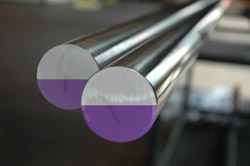
Type304 Stainless SteelIs the most widely used of the austenitic (chromium/nickel) stainless steels. In the annealed condition it is essentially non-magnetic and becomes slightly magnetic with the application of cold work. Type304L Stainless SteelIs preferred in welding applications to exclude the formation of chromium carbides during cooling in the heat affected region of the weld. these alloys represent an excellent combination of corrosion resistance and fabricability.
Product Forms:Sheet, Strip
Backed by Industry Standards:- UNS S30400/03
- ASTM A182
- ASTM A276
- ASTM A479
| Element | Type 304 | Type 304L |
| Carbon | 0.07Max | 0.030 Max |
| Manganese | 2.00Max | 2.00 Max |
| Sulfur | 0.030 Max | 0.030 Max |
| Phosphorus | 0.045 Max | 0.045 Max |
| Silicon | 0.75 Max | 0.75 Max |
| Chromium | 17.5 to 19.5 | 18.0 to 20.0 |
| Nickel | 8.0 to 10.5 | 8.0 to 12.0 |
| Nitrogen | 0.10 Max | 0.10 Max |
| Type | Yield Strength 0.2% offset (KSI) | Tensile Strength (KSI) | % Elongation(2" Gauge length) | Hardness Rockwell |
| 304 Ann | 30 min. | 75 min. | 40 min. | HRB 92 max. |
| 304? Hard | 75 min. | 125 min. | 12 min. | HRC 25-32 (typical) |
| 304? Hard | 110 min. | 150 min. | 7 min. | HRC 32-37(typical) |
| 304L Ann | 25 min. | 70 min. | 40 min. | HRB 92 max. |
| 304L? Hard | 75 min. | 125 min. | 12 min. | HRC 25-32 (typical) |
| 304L? Hard | 110 min. | 150 min. | 6 min. | HRC 32-37 (typical) |
304 & 304L | ||
Density (lb./ in^2) @ RT |
0.29 | |
Modulus of Elasticity in Tension (psi x 10^6) |
28.0 | |
Specific Heat (BTU/o F/lb.) |
32 to 212 of |
0.12 |
Thermal Conductivity (BTU/hr/ft^2/ft) |
212oF |
9.4 |
932oF |
12.4 | |
Mean Coefficient of Thermal Expansion (in. X 10^-6 per o F) |
32 to 212oF |
9.2 |
32 to 600oF |
9.9 | |
32 to 1,000oF |
10.2 | |
32 to 1,200oF |
10.4 | |
Electrical Resistivity (micro ohms - cm) |
at 70oF |
72 |
Melting Point Range (of) |
2550 to 2650 | |
Oxidation Resistance - Continuous Service(of) |
1,650 | |
Oxidation Resistance - Intermittent Service(of) |
1,500 |
Types 304 and 304L cannot be hardened by thermal treatment. Annealing: Heat to 1850o F to 2050 o F and cool at sufficiently high rates through 1500oF to 800oF to avoid precipitation of chromium carbides. Stress Relief Annealing: Cold worked parts should be stress relieved at 750oF for? to 2 hours.
Forming:Annealed Types 304 and 304L can be fabricated by roll forming, deep drawing, bending and most other fabrication techniques. Due to the high work hardening rate of these materials, intermediate anneals maybe required to successfully fabricate the part.
Welding:Types 304 and 304L are weldable by most fusion or resistance welding techniques. If filler metal is required, Type 308 is normally used. Type 304L should be used in heavier sections to reduce the occurrence of carbide precipitation in the heat affected region adjacent to the weld pool
Corrosion:Types 304 and 304L provides corrosion resistance in a wide range of moderately oxidizing and reducing conditions, fresh water and non-marine applications
Typical Applications:
Chemical equipment and piping, heat exchanger components, dairy and food handling equipment and utensils, cryogenic vessels and components, architectural and structural applications exposed to non-marine atmospheres
