



| Technique: | Hot Rolled |
|---|---|
| Type: | Steel Plate |
| Brand Name: | OEM |
| Thickness: | 5-200MM |
| Standard: | DIN |
Quick Details
Specifications
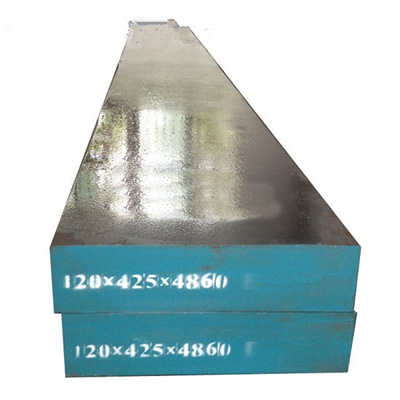
Overview
Designation by Standards
| Steel No. | DIN | EN | AISI | JIS |
| 1.2345 | X50CrVMo51 | - | Approx. H11 | / |
Chemical Composition (in weight %)
| C | Si | Mn | Cr | Mo | Ni | V | W | Others |
| 0.48-0.53 | 0.80-1.10 | 0.20-0.40 | 4.8-5.2 | 1.25-1.45 | - | 0.80-1.0 | - | - |
CHEMICAL COMPOSITION (WEIGHT %)
C (%): 0.48 ~ 0.53
Si (%): 0.80 ~ 1.10
Mn (%): 0.20 ~ 0.40
P (%)≤: 0.030
S (%)≤: 0.030
Cr (%): 4.80 ~ 5.20
Mo (%): 1.25 ~ 1.45
V (%): 0.80 ~ 1.00
Si (%): 0.80 ~ 1.10
Mn (%): 0.20 ~ 0.40
P (%)≤: 0.030
S (%)≤: 0.030
Cr (%): 4.80 ~ 5.20
Mo (%): 1.25 ~ 1.45
V (%): 0.80 ~ 1.00
Description
1.2345 steel is a 5% chromium hot work tool steel designed particularly for applications requiring extreme toughness combined with good red hardness. It provides an extra margin of safest in tools subject to heavy hammer blows, and those tools containing deep recesses or sharp corners. while 1.2345 has been designed primarily as a hot work tool steel, it has been used in many cold work applications where extra toughness is required at the sacrifice of some wear resistance.
Applications
1.2345 has been used primarily for tools requiring resistance to softening at elevated temperatures. Such tools include forging dies and punches, die-casting dies, aluminum extrusion dies, hot heading dies, piercing and forming punches, etc.
Physical properties (avarage values) at ambient temperature
Modulus of elasticity [103 x N/mm2]: 215
Density [g/cm3]: 7.70
Thermal conductivity [W/m.K]: 25.0
Electric resistivity [Ohm mm2/m]: 0.52
Specific heat capacity[J/g.K]: 0.46
Coefficient of Linear Thermal Expansion 10-6 oC-1
| 20-100℃ | 20-200℃ | 20-300℃ | 20-400℃ | 20-500℃ | 20-600℃ | 20-700℃ |
| 11.7 | 12.5 | 12.7 | 13.2 | 13.4 | 13.6 | 13.8 |
Soft Annealing
Heat to 760-820℃, cool slowly in furnace. this will produce a maximum Brinell hardness of 250.
Stress Relieving
to relieve machining strains for greater accuracy in hardening, first rough machine, then anneal below the critical 649/677℃ a minimum of one hour at temperature, and cool very slowly, followed by finish machining.
Hardening
Harden from a temperature of 1000-1040℃ followed by air, oil warm bath (450-550℃) quenching. Hardness after quenching is 54-58 HRC.
Tempering
Tempering temperature: See the diagram bellow.
Tempering Temperature (℃) vs. Hardness (HRC) vs. Tensile Stregth (N/mm2)
| 100℃ | 200℃ | 300℃ | 400o℃ | 500℃ | 550℃ | 600℃ | 650℃ | 700℃ |
| 56 | 55 | 53 | 54 | 56 | 54 | 49 | 40 | 31 |
| 2050 | 1980 | 1845 | 1910 | 2050 | 1910 | 1620 | 1260 | 995 |
Forging
Heat slowly and uniformly to a temperature of between 1093/1135℃ and forge. Do not work the steel below 927℃. Reheat as often as necessary.
Machinability
the machinability of 1.2345 may be rated between 55% and 65% of a 1% carbon water hardening tool steel, or about 40% to 50% of B1112.
Weldability
to salvage tools and dies by welding, preheat to 538℃ in a furnace and weld with uncoated arc equipment (atomic hydrogen or heliarc). Keep the temperature of the die above 316℃ at all times by reheating until the welding is completed. upon completion of the weld, return the work piece to the preheating furnace, equalize, and cool in the furnace. Welding should be performed in the annealed condition. however, if welding is performed in the hardened condition, the tool should be retempered at 538℃ after hardening. the electrode material used in the weld rod should be of similar analysis to the base material.