



| Rated Voltage: | 250, 275, 300, 305, 310 VAC |
|---|---|
| Capacitance: | 0.001uF~2.2uF |
| Application: | Air Conditioner |
| Type: | Ceramic Capacitor |
| Brand Name: | JEC |
| Operating Temperature: | -40-125 degrees Celsius |
| Package Type: | Surface Mount |
| Place of Origin: | China (Mainland) |
Quick Details
Specifications
Product name |
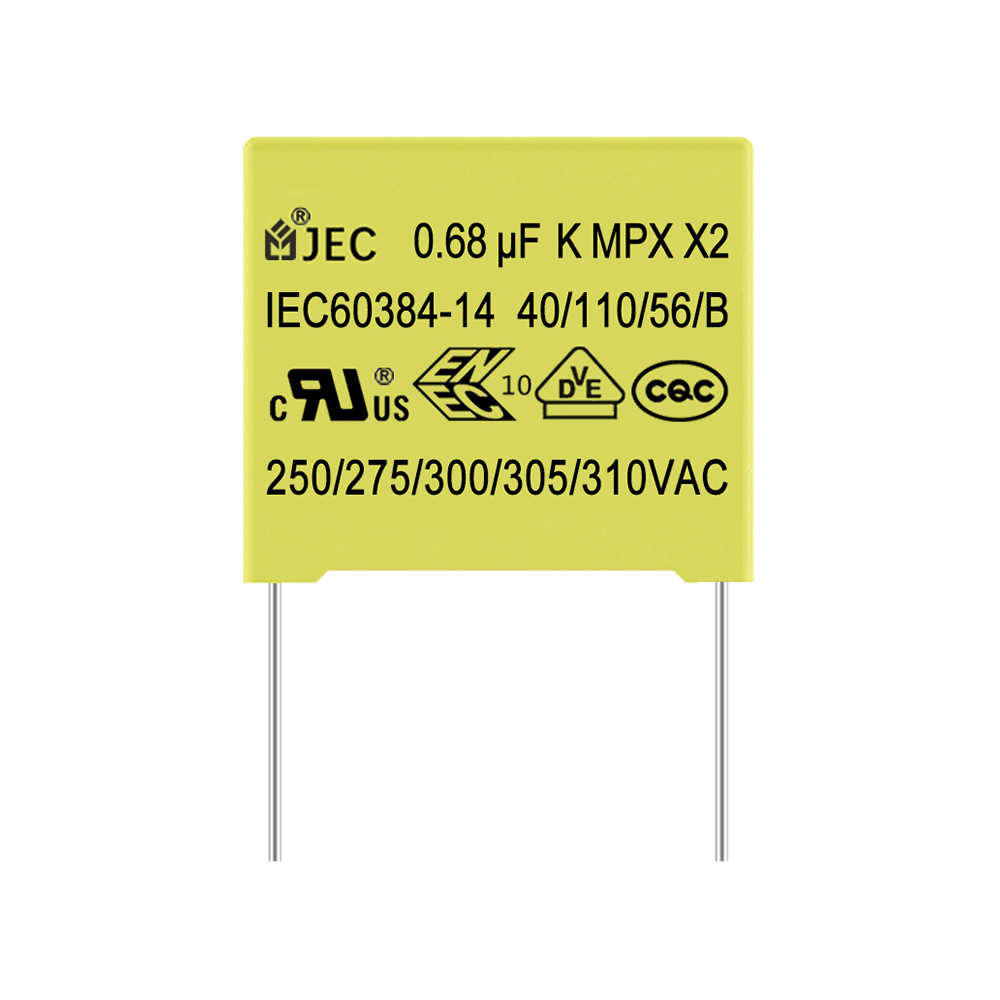
X2 Safety Capacitor Polypropylene Film Capacitor |
Type |
MPX (MKP) |
ApprovalSTandards |
IEC 60384-14 |
Features |
Non-inductive Structure High moisture-resistance Self-healing property Flame retardant type (Compliance with UL94V-0) Very small loss Excellent frequency and temperature characteristics High insulation resistance |
Rated Voltage |
250/275/300/305/310VAC |
Application |
WIdely used in the suppression of electromagnetic interference and power connection circuits, especially suitable for dangerous situations where the use of capacitors will not cause electric shock after failure. |
Capacitance Range(uF) |
0.001uF~2.2uF |
OperatingTempErature(℃) |
-40℃~105℃ |
CUstomization |
Accept Customized content andProvide sample services |
Dongguan Zhixu Electronic Co., Ltd. (also JYH HSU(JEC))Factories are ISO-9000 and ISO-14000 certified. JEC X2, Y1, Y2 capacitors and varistors have passed these certifications:
CQC (China)
VDE (Germany)
CUL (America/Canada)
KC (South Korea)
ENEC (EU)
CB (International Electrotechnical Commission)
All of our capacitors are in line with the EU ROHS directives and REACH regulations.
FAQ
Q: What are the materials of ceramic capacitors?
A: 3 types in total: Y5P, Y5U, Y5V.
Q: What is the capacitance range of X2 capacitors?
A: the capacitance range is 0.001uf-2.2uf
+Q: how many types of pitch distance are there for 0.1uf X2 capacitors?
A: There are two types: 10mm and 15mm, the regular one is 10mm.
Q: What is the voltage range of your high-voltage ceramic capacitors?
A: the voltage range of our high-voltage ceramic capacitor is 1KV-100KV.
Q: What is dissipation factor (DF) of film capacitors?
A: the DP of a capacitor is the power loss when AC is applied through the capacitor. this power is either absorbed by the dielectric material or internal/external resistance. Externally, the leads, pads, and solder all lead to an increase in resistance.