



| Brand Name: | green filter |
|---|---|
| name: | EDI |
| Material: | Aluminum |
| application: | water filtration |
| Type: | 0.5T/h-5T/h |
| Model Number: | 0.5T/h-5T/h |
| Place of Origin: | China (Mainland) |
| Productivity: | 3T/Hour, 5000L/Hour |
| Max. pressure: | 0.4Mps |
| Weight: | 150kg |
| Core Components: | Pressure vessel, Pump, PLC, edi |
Quick Details
Specifications
What is Electrodeionization?
Electrodeionization (EDI) is an electrically-driven water treatment technology that uses electricity, ion exchange membranes and resin to remove ionized species from water.
the limitations of EDI differ from conventional ion exchange. in the latter scenario product water ionic purity is essentially limited by the total number of ions taken up by the resins. EDI is limited by the maximum rate of arrival of ions. Too high an ionic load will tend to overload the module. EDI is, therefore, often used after reverse osmosis and, if the water is very hard, with degassing to remove carbon dioxide.
What does Electrodeionization remove from water?
EDI removes ions and other charged species from water, for example salts and organic acids.
how does Electrodeionization work?
the EDI module consists of a set of chambers filled with ion exchange resins and separated by ion-exchange membranes. Water enters the module, where an applied electrical field at right-angles to the flow forces ions to move through the resins and across the membranes. these impurity ions are not permanently bound to the media but instead are collected into concentrate streams which can be directed to drain or recycled. The deionized product water can be used directly or undergo further treatment for enhanced water purity.
the EDI module acts, in effect, as an ion exchange bed which is continuously regenerated electrically. When the ions are moved through the resins and between the cation or anion selective membranes, they are exchanged for H+ and OH- ions. Ions that become bound to the ion exchange resins eventually migrate to a separate chamber under the influence of the externally applied electric field; this also produces the H+ and OH- ions necessary to maintain the resins in their regenerated state. Ions in the separate chamber are flushed to waste.
the limitations of EDI differ from conventional ion exchange. in the latter scenario product water ionic purity is essentially limited by the total number of ions taken up by the resins. EDI is limited by the maximum rate of arrival of ions. Too high an ionic load will tend to overload the module. EDI is, therefore, often used after reverse osmosis and, if the water is very hard, with degassing to remove carbon dioxide.
What are the benefits of Electrodeionization?
the ion exchange beds in the EDI systems are regenerated continuously so that they do not exhaust in the same way as ion exchange beds that are operated in batch mode. as the impurities are removed via the concentrates, they do not build-up and exhaust the resin. An EDI unit may operate for many years before a replacement is required. Typically product water resistivity of >15 MΩ.Cm is consistently achieved using this process. this technology can be used as an alternative to single-use purification cartridges. as well as the practical advantages and reduction in down-time of avoiding changing cartridges, EDI can also deliver more consistent purity than single-bed ion-exchange systems that may release weakly bound ions as the media exhausts. The smaller volumes of resin in an EDI module (compared to an ion-exchange bed) also reduce the release of organic impurities.
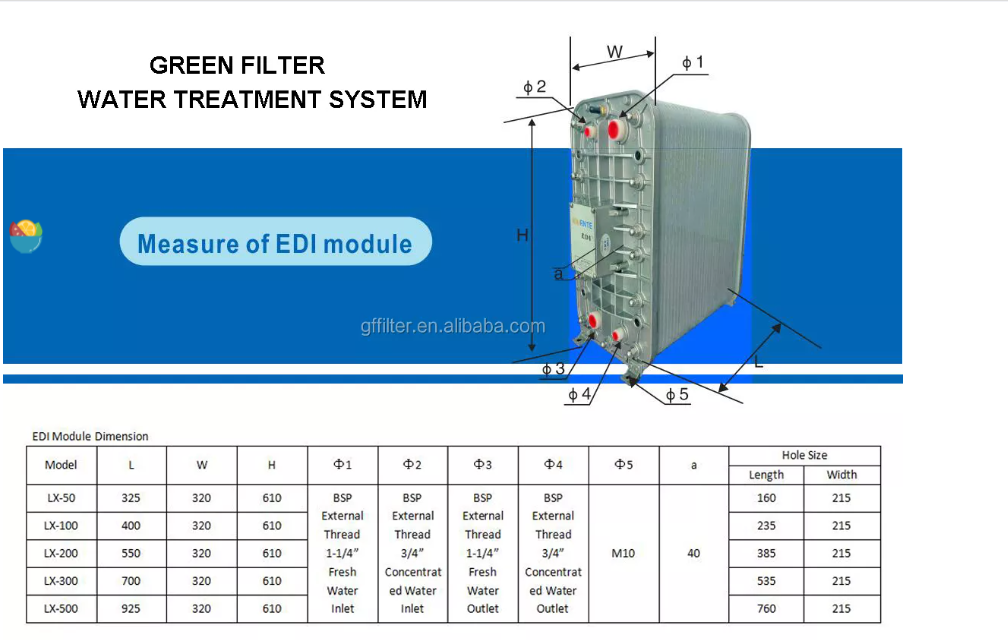
Specification:
FAQ:
Q1: Are you a manufacturer or trading company?
A1: We are a manufacturer of FRP tanks, membrane housing, RO membrane located in Tianjin.
Q2: Your MOQ?
A2: 1 piece.
Q3: Why do you have higher prices than other companies?
A3: for the same quality products, we are committed to providing the lowest price.
Q4: how long do you need to produce a cycle?
A4: We have some stock of normal products, 1-3 days for customized samples; 7-25 days for batch goods.
Q5: What products do you offer?
the ion exchange beds in the EDI systems are regenerated continuously so that they do not exhaust in the same way as ion exchange beds that are operated in batch mode. as the impurities are removed via the concentrates, they do not build-up and exhaust the resin. An EDI unit may operate for many years before a replacement is required. Typically product water resistivity of >15 MΩ.Cm is consistently achieved using this process. this technology can be used as an alternative to single-use purification cartridges. as well as the practical advantages and reduction in down-time of avoiding changing cartridges, EDI can also deliver more consistent purity than single-bed ion-exchange systems that may release weakly bound ions as the media exhausts. The smaller volumes of resin in an EDI module (compared to an ion-exchange bed) also reduce the release of organic impurities.
Specification:
FAQ:
Q1: Are you a manufacturer or trading company?
A1: We are a manufacturer of FRP tanks, membrane housing, RO membrane located in Tianjin.
Q2: Your MOQ?
A2: 1 piece.
Q3: Why do you have higher prices than other companies?
A3: for the same quality products, we are committed to providing the lowest price.
Q4: how long do you need to produce a cycle?
A4: We have some stock of normal products, 1-3 days for customized samples; 7-25 days for batch goods.
Q5: What products do you offer?
A5: We can offer most water treatment products at a good price.