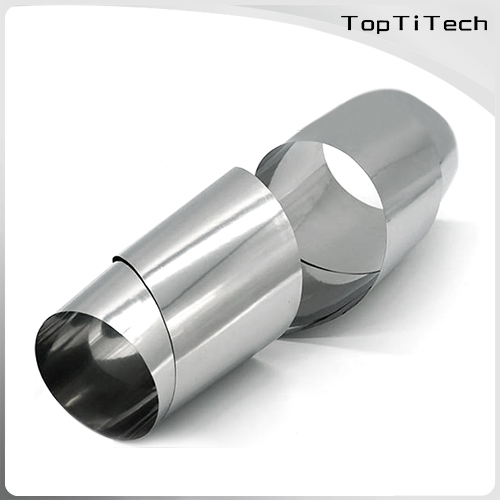



Foil refers to any metal sheet with a thickness of 0.2mm or less. Heavy gauge foil, medium gauge foil, and light gauge foil are categorized according to the thickness of the metal foil. the thickness ranges from 0.2mm to 0.1mm for heavy gauge foil, 0.1mm to 0.09mm for medium gauge foil, and 0.001mm for light gauge foil.
at the moment, the thinnest foil that can be rolled in an industrial setting is 0.0045mm thick. Aluminum foil currently produces the most, accounting for over 85 percent of worldwide metal foil production. China is the leading producer and exporter of aluminum foil in the world. In 2021, the output was 4050 KT or around 65 percent of the global total.
Titanium foils are difficult to produce, expensive, and low-yielding. Therefore, titanium foils are not widely used. Aircraft skin insulation material is one of its high-end applications. When an airplane is in the air, its metal shell heats up because of strong friction with the air. In order to prevent heat from entering the interior, an aircraft must have a heat insulation protective layer.
It is welded by four layers of heat insulation plates, with a thinner fat layer in the middle. this picture shows a diagram of the heat insulation plate part, made from 0.08mm TB2 alloy foil. TB2 is a β titanium alloy.
in the countries such as the United States and France, manufacturers use superplastic forming technology to produce titanium foil insulated plates. Although the technology can process high-quality heat insulation plates, the production cycle is long. If the workpieces are in a high-temperature state for a long time, they will absorb oxygen. Titanium no longer has oxidation resistance above 649 ℃. Hence, it will absorb more oxygen and become brittle, so the mechanical properties will decline. In addition, superplastic forming is suitable for simple workpiece shapes. For the complex workpiece shown in Figure 2, it is difficult to superplastic forming, because molds processing is not easy.
the insulation board should be accurate, with strict control of oxygen content. Therefore, it is best to weld in a vacuum furnace. however, it requires expensive equipment, which increases the investment and makes the operation more difficult. For this reason, a research institute in China has proposed sheath protection technology and successfully manufactured titanium foil aircraft heat insulation plate with low cost and high quality.
during production, the TB2 alloy foil is placed inside the sheath first. Before thermal forming, the oxygen in the sheath is removed by the conventional vacuuming method and then seal the sheath.