



| Brand Name: | FUYANG |
|---|---|
| Type: | Sweeteners |
| EINECS No.: | 208-999-7 |
| Other Names: | D-allulose |
| CAS No.: | 551-68-8 |
| Model Number: | a1 |
| Place of Origin: | China (Mainland) |
| FEMA No.: | / |
| MF: | fuyang |
| Ph: | 3.0-7.0 |
| color: | white |
Quick Details
Specifications
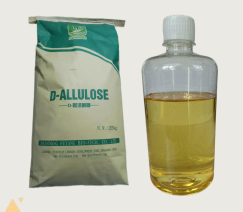
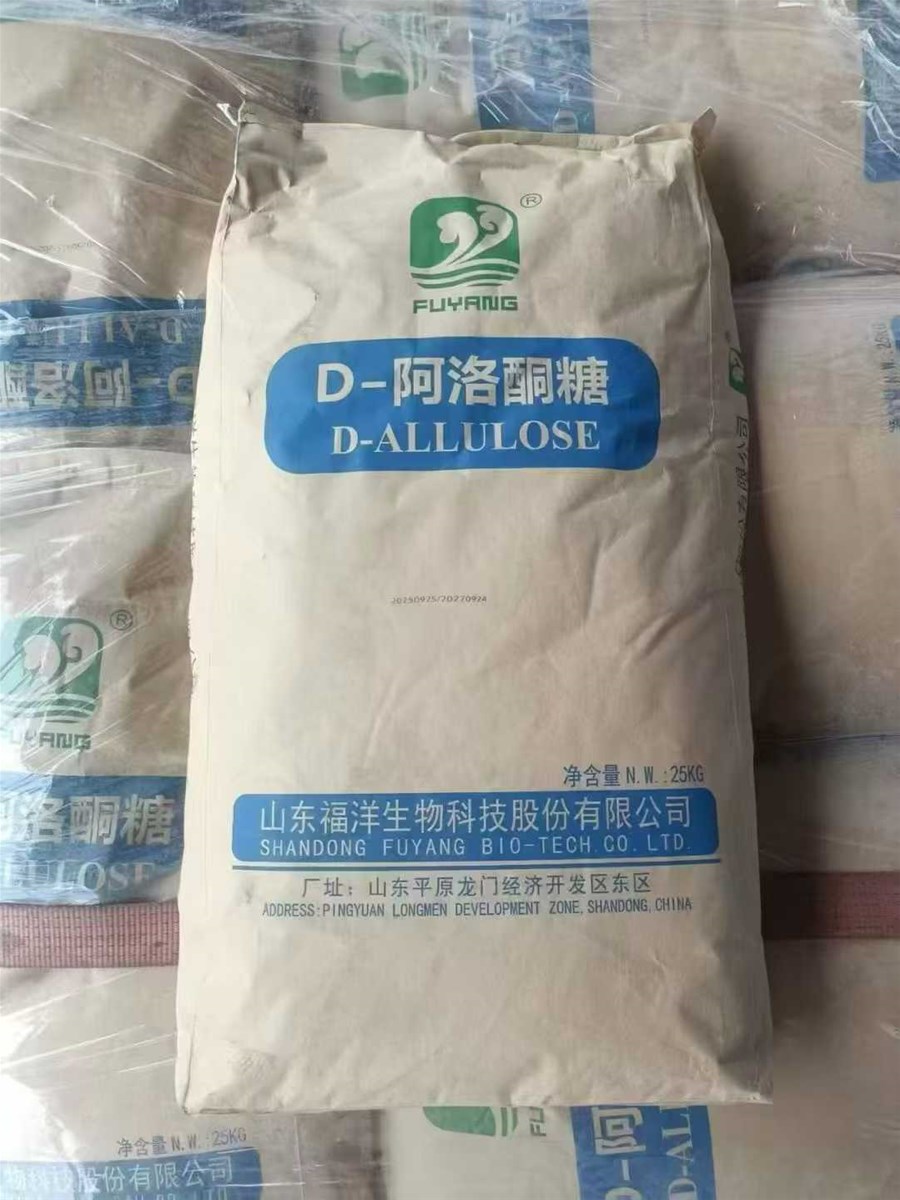
D-Allulose is called D-ribose-2-hexulose, which is a kind of rare sugar. It exists in a small amount in nature and is the epimer of the C-3 position of D-fructose. D-Allulose is a white powder, and its aqueous solution is a transparent colorless liquid, which is stable at normal temperature and pressure.
D-Allulose has the advantages of high sweetness, good solubility, low calorie and low blood sugar response, and is considered to be one of the ideal sucrose substitutes. Adding D-Allulose to food can not only improve its gelling degres, but can produce Maillard reaction with food protein to improve its flavor.
D-psicose can be used as the most ideal substitute for sucrose in food due to its low sweetness, high solubility, extremely low caloric value and low blood sugar reaction;
D-psicose can undergo Maillard reaction by binding with proteins in food, thereby improving its gel properties and producing good chemical flavor;
Compared with D-glucose and D-fructose, D-psicose can produce higher anti-Maillard reaction products, thereby allowing food to maintain a higher level of antioxidant effect during long-term storage, effectively extending the shelf life of food;
Improve the emulsification stability, foaming performance and antioxidant activity of food.
D-Allulose has the advantages of high sweetness, good solubility, low calorie and low blood sugar response, and is considered to be one of the ideal sucrose substitutes. Adding D-Allulose to food can not only improve its gelling degres, but can produce Maillard reaction with food protein to improve its flavor.
D-psicose can be used as the most ideal substitute for sucrose in food due to its low sweetness, high solubility, extremely low caloric value and low blood sugar reaction;
D-psicose can undergo Maillard reaction by binding with proteins in food, thereby improving its gel properties and producing good chemical flavor;
Compared with D-glucose and D-fructose, D-psicose can produce higher anti-Maillard reaction products, thereby allowing food to maintain a higher level of antioxidant effect during long-term storage, effectively extending the shelf life of food;
Improve the emulsification stability, foaming performance and antioxidant activity of food.